I have made it no secret that I am not the biggest fan of AI. As a graphic designer, I have my own personal gripes. I shudder when I see an AI-generated logo or poster. I worry about job security and a world full of soulless AI “art.”
The more I learn about artificial intelligence, though, the less personal it becomes. To me, for every positive argument for AI, there are ten negatives. Generating a funny photo for an Instagram trend has ripples that aren’t immediately obvious. The legal and ethical implications are ever-present in the life of everyone on our planet.
Legal Concerns
As artificial intelligence grows and adapts, so must the laws around it. Over the past couple of years, lawsuit after lawsuit have popped up. Among some of the main concerns? Plagiarism and privacy.
“It’s an exciting time, but it’s a bit of a legal minefield out there right now.”
Regina Sam Penti, law partner at Ropes & Gray
AI models are being fed huge amounts of data to train them. This teaches the AI’s algorithm to predict responses based on the patterns it recognizes. The exact data the AI is being trained on directly affects its response. Because of this, it’s raised many legal concerns.
Plagiarism
When you generate a piece of content, for example, it’s not automatically plagiarism. You won’t get an exact word-for-word result, but something similar based on a multitude of different sources.
This creates a lot of gray areas. If AI is trained on someone’s code or their art, who owns that intellectual property? If AI pulls information from copyrighted art and images, where is the line? Work created entirely by AI isn’t protected under copyright laws, but work with an added human touch can be.
Fundamentally, how AI operates poses a challenge for copyright laws. It’s new territory that hasn’t been completely explored. The line blurs between what’s allowed and what’s not, creating a legal minefield.
Privacy
Another big concern is data privacy. AI scrapes loads of data from across the internet, giving it access to information people don’t always want public. This can lead to security risks and breach client confidentiality.
Meta wants to start training their AI on data from business accounts, but is being met with major backlash. Their users simply don’t want their private data being used in this way, and currently in the United States, there is no opt-out option.
If AI gets a hold of private data, there’s a risk that it becomes not so private anymore. That’s why many companies have their own internal AI model, so no sensitive information comes up in AI searches. Not to mention, there are concerns about people’s likeness being used without their consent through deepfakes. AI has the power to create and expose whatever it comes in contact with, so it’s important to use it wisely to avoid lawsuits, leaks, and legal action.
Ethical Concerns
Now I don’t have time to deep dive into every ethical concern that AI raises. Below are some of my top ethical concerns with AI and what I think is important for users to know:
Water and Energy
Data centers need to use a lot of water and energy to operate. To cool their machines, the AI industry is estimated to have used around 23–33 billion gallons of water in 2025. That’s about 175 billion standard-size water bottles.
Data centers also use a ton of energy. In fact, data centers account for 4.7% of our national energy consumption, already up 14% in just a year. A single, “prompt uses roughly 0.2 to 2 watt-hours of electricity,” according to aiwateruse.org.
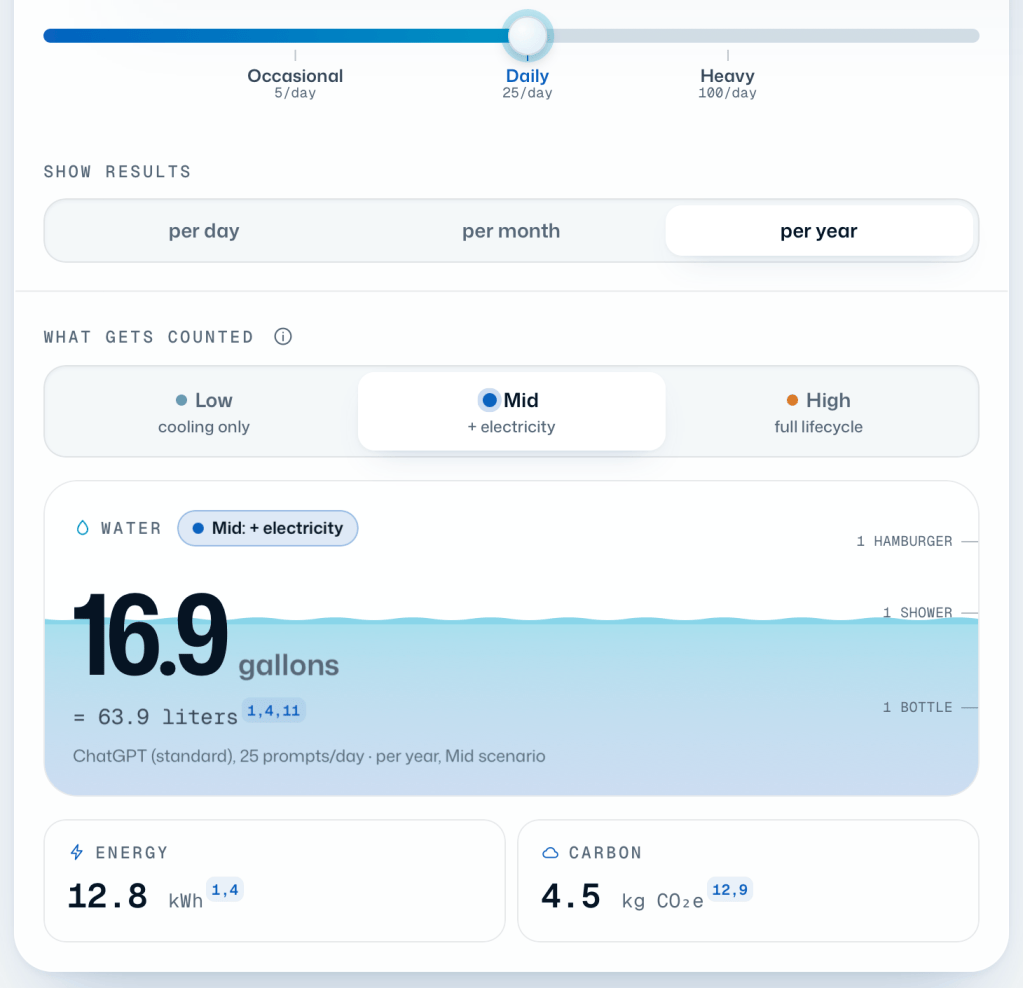
I recommend testing out a more sustainable alternative that uses less water and energy, with a carbon-neutral server like EcoGPT (they even plant trees for every 100 prompts).
Data Centers and the Communities They Invade
Data centers are popping up all over the country. There’s a clear influx in marginalized communities. 550 U.S. data centers within a mile radius are “disproportionately in communities of color and have air pollution levels above the national average,” says the Center for Health Journalism.
This leaves communities already at the bottom of the totem pole victim to noise pollution. Data centers aren’t quiet. While we don’t have exact data on the decibel level right now, it’s loud and constant enough to impact the towns they’re in. People in these communities have reported frequent headaches, nausea, vertigo, and trouble sleeping.
When to Use AI-Generated Content
Telling you when to use AI is hard. After everything we just talked about, I’d love to tell you to just not. But I understand that’s unrealistic and, honestly, not all too helpful. Here’s how I’d recommend implementing it:
- Repurposing content for other platforms
- A jumping-off point for captions and ideas
- Expanding your content library on a budget
- Make your current content more versatile
- Use it to find keywords to make your posts more optimized for SEO and GEO
What to Avoid Doing
- Posting content before reviewing and editing it: avoid having misinformation via “hallucinations” made by AI
- Not noting if content was made by AI: This can deceive your audience if not included and lead them to trust you more if you mention it wasn’t.
- Using AI for projects containing sensitive information.
- Creating images, videos, or audio clips of a real person without their consent.
- Using AI more than necessary, plus you don’t need to say thank you.
Now I’m aware generative artificial intelligence isn’t going anywhere anytime soon. I understand that in some situations it is unavoidable. As you move forward, I urge you to be more thoughtful about what you use AI for. Understand what you’re doing when you hit “enter” on your prompt.


Leave a Reply